
You Have a Notetaker. So Why Are Things Still Falling Through the Cracks?

You did the thing. You adopted the AI notetaker. Summaries land in your inbox before you've even closed the Zoom tab. Action items are extracted. Transcripts are searchable. You're "moving faster."
So why does Monday still feel the same?
A Tuesday that keeps repeating
I'll paint a picture. You had a solid 1:1 with your report last Tuesday. Good conversation. You talked about the roadmap blocker, agreed on next steps, said you'd loop in the design lead. The notetaker caught all of it—clean summary, three action items, timestamps.
A week later you sit down for the next 1:1. You open the notes from last time. You skim them. Huh—did you ever loop in the design lead? You're not sure. Your report brings up the roadmap blocker again. You realize you're having the same conversation. Again.
The notes were perfect. Nothing moved.
I've watched this pattern play out with our own team, with our early users, with every manager I've talked to who adopted a notetaker and felt like something was still off. The notes got better. The follow-through didn't.
Notetakers: real value, wrong finish line
Let me be clear—AI notetakers were a genuine unlock. Before them, you were either scribbling during a meeting and missing half the conversation, or you were fully present and walking away with nothing written down. That's a real problem and notetakers solved it.
But somewhere along the way, we confused the unlock with the finish line.
A notetaker is a recording device with a language model on top. It joins your call, captures what was said, and organizes it into something readable. That's its entire job. It doesn't know why you're meeting. It doesn't know what you discussed last time. It doesn't know that the action item it just extracted is the same one that's been extracted—and ignored—for three consecutive weeks.
It doesn't know that you're stuck.
The feeling underneath the productivity
Here's the thing nobody says out loud: after adopting AI for meetings, a lot of us feel more overwhelmed, not less.
You now have 47 perfect summaries in a folder you opened twice. Action items extracted into a list that quietly went stale. A transcript archive that's technically searchable but practically invisible. And you're skimming AI summaries on top of everything else you were already behind on.
One of our early users put it perfectly: "I have more meeting artifacts than ever. I don't think a single one changed what I actually did the next day."
More output. Same overwhelm. Maybe worse, because now it looks like you have it together.
What I actually wanted from my meetings
When I stopped thinking about tools and started thinking about what I actually needed, it came down to two things. Not features—outcomes.
Did anything actually get done?
Not "were things written down." Were things done.
I'll give you a specific example. Last month we had a customer call where we committed to three things: a follow-up email with technical specs, an intro to our partnerships lead, and a pricing proposal by Friday. Classic post-meeting commitments. In the notetaker era, those would've been three bullet points in a summary. Maybe I'd copy them into a task list. Maybe I wouldn't. By Thursday, I'd be scrambling to remember what I promised.
Instead, the follow-up email drafted itself from the meeting context. The intro message was queued. The pricing proposal showed up as a tracked commitment with a Friday deadline. When Friday morning hit and I hadn't sent the proposal, I got nudged.
That's not better notes. That's less on my plate. The gap between "action item extracted" and "action item completed" is where most work quietly falls apart. Closing that gap—automatically—is what actually changes your week.
Did I get better?
This is the one that surprised me.
I run a lot of meetings. I'd guess 20+ a week. For years, each one existed in isolation—I'd show up, do my best, move on. A notetaker didn't change that; it just gave me a record of each isolated event. Like a camera that takes photos but never makes an album.
The shift happened when my meetings started connecting to each other. A Friday reflection showed up that pulled threads across the whole week—what moved, what stalled, where I kept getting stuck. It surfaced patterns I couldn't see when I was living inside them: that my 1:1s were stronger when I prepped the night before. That I tended to let scope creep go unchallenged in group settings. That a particular report's blocker had been "in progress" for four consecutive weeks.
Here's what one of those weekly reflections looks like—it connects meetings, priorities, open loops, and coaching into a single view:
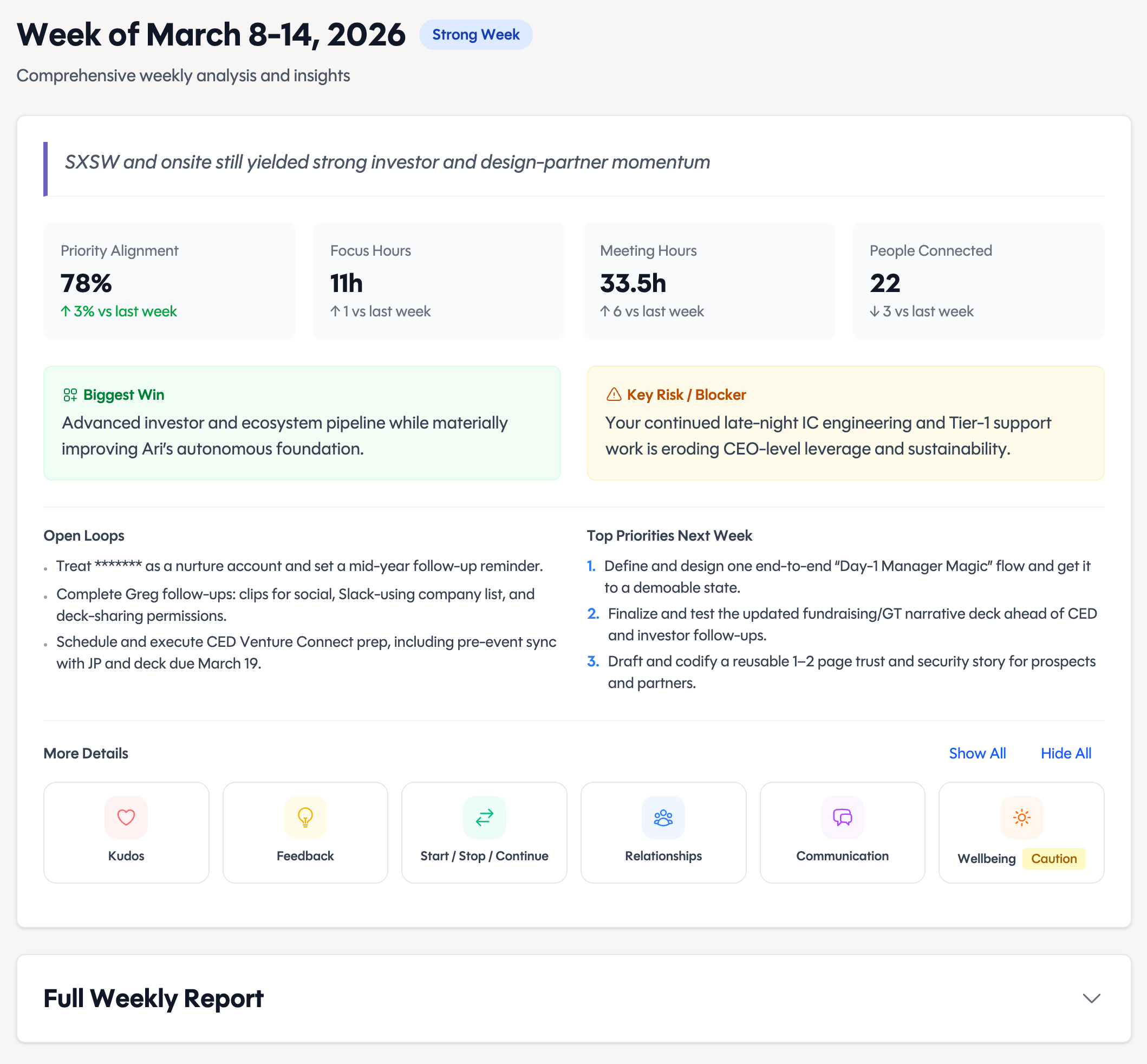
One of our teammates, Shawn, said something that stuck with me: "Ari picks up on things I didn't even think about—like when to schedule shorter follow-ups or how to structure feedback templates. It's the kind of insight that compounds over time." That's not transcription. That's growth. And it only emerges across meetings, across weeks—across a rhythm.
A notetaker gives you a record. What you actually need is a mirror.
The gut-check
I'll leave you with the questions I ask myself:
- Are fewer things falling through the cracks than six months ago?
- Can I name one way my meetings improved—not my notes, my meetings?
- Is my week lighter, or just faster?
- When's the last time something in my stack caught a ball I was about to drop?
- Have I gotten better at running meetings—or just better at documenting them?
If you're not sure, you're not alone. Most of us adopted AI for meetings and got a faster version of the same problems.
What we're building toward
We think about this every day at Ariso. Not the capture problem—that's solved. The two problems that come after it.
The offloading problem: how do you build a system where follow-throughs don't depend on your memory? Where prep happens before you think about it, follow-ups close themselves, and your week gets genuinely lighter—not just better documented?
The growth problem: how do you turn hundreds of meetings into actual insight about how you work? How do you make every 1:1 a little sharper than the last? How do you make reflection something that happens, not something you aspire to?
The answer to both isn't a better notetaker. It's a system that treats every meeting as a passage in an ongoing loop—where the preparation, the follow-through, and the learning are all connected.
We're building for the loop.
Erkang Zheng is the Founder and CEO of Ariso. Before starting Ariso, he founded JupiterOne, and worked on security and infrastructure at several leading technology companies.
LinkedInReady to try Ari?
The AI player-coach that gives every employee the tools to lead themselves.